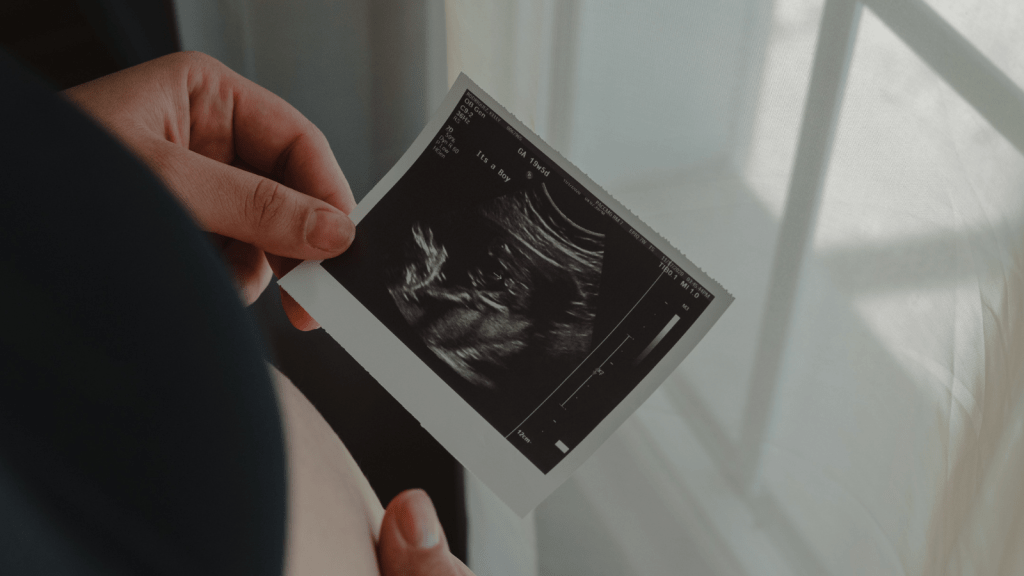
We’ve all heard people argue for abortion. We’ve heard phrases like “My body, my choice”, claims like “Abortion is healthcare”, and “It’s my right”. It’s easy to refute these statements, with simple logic, but ultimately the person you’re debating remains unconvinced because you haven’t addressed your foundational disagreement: personhood and the value of human life.
Pro-Lifers cling to this idea of personhood from conception. If this is true, then abortion is the intentional murder of the most innocent people among us. But are they right? Let’s take a look at the development of the human fetus and see if science can give us the answer.
When the sperm and the egg meet in the woman’s fallopian tube, the sperm penetrates the eggs outer shell, called the corona radiata. The sperm then is buried in the egg itself, which causes the egg to change, preventing other sperm from penetrating the egg. At this point, the head of the sperm dissolves, releasing the nucleus, which has the father’s DNA. It fuses with the egg’s nucleus, which has the mother’s DNA. This happens about 12 to 24 hours after fertilization and the egg is now called a zygote.
In the next 5 to 6 days, the zygote travels down the fallopian tube, meanwhile splitting into multiple cells within the outer shell. By the time it arrives at the uterus has split into 16 cells. It is now called a blastocyst.
The blastocyst hatches out of its shell and burrows into the uterus lining. This establishes nutrient exchange and later becomes the placenta.
At about 4 weeks from the last period, the woman’s body releases the pregnancy hormone to tell the ovaries to stop releasing eggs. The blastocyst is called an embryo. It is possible to receive a positive result to a pregnancy test at this point.
At week 5, the circulatory system, brain, and spinal cord have begun to form and the embryo has a tiny beating heart. By week 7 it has doubled in size. At about weeks 9 to 12 tiny hands and feet form and it is now called a fetus.
From this point on, the fetus continues to develop and grow in size until birth.
As we see from this pregnancy overview that development is very gradual and there is no clear stage we can point to and say “this is where life begins”. Even conception is a bit ambiguous. Some object to the idea that human individuality begins at conception, because of the 12 to 24 hours before the DNA of the individual has formed. This objection is obsolete because no abortions happen at this stage. The mother has no way of knowing if she is pregnant! Other’s ground their objection on the possibility of identical twins, also called paternal or monozygotic. They make an interesting point, and this puzzled me during my research. Let’s dive in.
Identical twins form, when a single fertilized egg splits into two. This usually happens 1 to 7 days after fertilization. This results in two embryos that have the same DNA. They are clones of each other. As cells split multiply the DNA is copied over and over again. Sometimes this copying results in mutations. So, while identical twins start out with the same DNA they end up differing very slightly.
Many Pro-Lifers argue that a child in the womb is a human individual, because from conception there is a genetically unique set of DNA. But what we just saw, in the case of identical twins, you can have one set of unique DNA that results in two people! Also, if this was completely accurate, we would become a completely different individual every time our DNA underwent a single mutation! While I agree with the conclusion of the argument, the premise is incorrect.
The obvious conclusion is that it is not DNA alone that makes a person. DNA is an organization of chromosomes that acts as a blueprint of physical traits. Plants and animals also have DNA, but do not have personhood or souls. So the DNA inside of a fertilized egg, determines that the egg is human, either male or female, and sets the trajectory for physical appearance, susceptibility to diseases, and many other personal traits. It looks like science cannot answer our question of personhood. What we’re searching for is a soul.
The obvious place to look is God’s holy Word.
Psalm 139:13-16 says:
“For You formed my inward parts;
You wove me in my mother’s womb.
I will give thanks to You, for I am fearfully and wonderfully made;
Wonderful are Your works,
And my soul knows it very well.
My frame was not hidden from You,
When I was made in secret,
And skillfully wrought in the depths of the earth;
Your eyes have seen my unformed substance;
And in Your book were all written
The days that were ordained for me,
When as yet there was not one of them.”
This is probably the most quoted “pro-life” Bible verse. It speaks to the purpose God places in the creation of human life, even “unformed” life. This verse makes no distinction in value between a human inside the womb and a human outside the womb. Jeremiah 1:5 has a similar message.
“Before I formed you in the womb I knew you, And before you were born I consecrated you;”
On another note, Psalm 51:5 says:
“Surely I was sinful at birth, sinful from the time my mother conceived me.”
How can a clump of cells, a fertilized egg be sinful? It can’t, unless it is a soul from the fallen race of Adam: a human life.
So, as we have seen, God’s Word makes no distinction between sinful people outside the womb and sinful people inside the womb. And if God’s Word is truly our standard for what is good and evil, then neither will we. The command “Thou shalt not murder” stands whether the victim has been alive for seven days or seventy years. It is time we start calling abortion what it is.
 The Ready Witness
Leave a comment